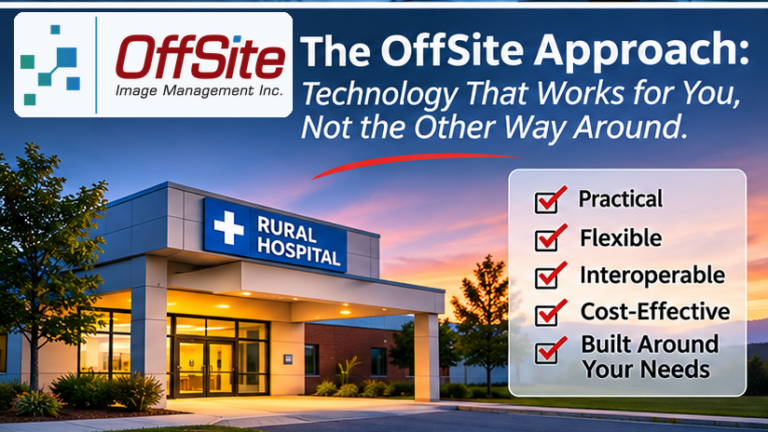
Small Hospital, Enterprise Imaging: Why Rural Healthcare Needs a Different Technology Strategy.
OffSite Image Management, Inc. | Healthcare Imaging Insights
A 25-bed critical access hospital and a 500-bed medical center may operate on dramatically different scales. Their patients, however, expect the same thing.
When a patient arrives in the emergency department with symptoms of a stroke, trauma, pulmonary embolism, or another potentially serious condition, the size of the hospital doesn’t change the need for fast diagnostic imaging. The CT still needs to be performed. The images still need to reach the radiologist. Prior examinations still need to be available. The report still needs to get back to the physician.
This creates a unique technology challenge for rural and critical access hospitals: How do you deliver enterprise-level imaging capability without an enterprise-level IT department?
Smaller Hospital Doesn’t Mean Simpler Imaging
It is easy to assume that smaller hospitals have simpler technology requirements. In radiology, that isn’t necessarily true.
A rural hospital may operate CT, X-ray, ultrasound, mammography, MRI, nuclear medicine, and other modalities. It may work with local physicians, outside specialists, multiple radiology groups, and teleradiology providers.
Behind a seemingly simple radiology examination may be DICOM routing, HL7 orders, patient demographics, accession numbers, reports, prior-study retrieval, and multiple interfaces. That isn’t a small technology environment. It’s a sophisticated imaging ecosystem operating inside a smaller organization.
The Staffing Problem
Large health systems can distribute responsibility across specialized teams. There may be separate personnel responsible for networking, cybersecurity, storage, interfaces, PACS administration, servers, clinical applications, and disaster recovery.
At a rural hospital, several of those responsibilities may fall on the same person or a very small team.
Servers need maintenance. Operating systems require updates. Storage needs monitoring. Interfaces need troubleshooting. Backups need verification. Security needs monitoring. Disaster-recovery plans need testing. PACS needs administration.
None of those responsibilities disappear because the hospital has fewer beds.
Cloud Imaging Changes the Infrastructure Equation
Cloud technology offers smaller hospitals an opportunity to change that model. Instead of building and maintaining every component of the imaging environment locally, portions of the infrastructure can be managed remotely.
A cloud PACS can reduce dependence on local servers and storage infrastructure while still giving radiologists and clinicians access to the imaging environment they need. Cloud archiving can provide another independent location for imaging data. Managed image routing can help studies reach the appropriate destinations. Pre-fetch technology can retrieve relevant historical studies before they are needed. Teleradiology can provide access to radiologists without requiring them to be physically present at the hospital.
The important point isn’t simply that these technologies are “in the cloud.” It is that they allow hospitals to transfer some of the operational responsibility for imaging infrastructure to organizations that specialize in managing it.
Interoperability Is Critical
A PACS does not operate in isolation. For imaging workflow to function efficiently, information needs to move between systems.
An order may originate in an EMR or RIS and travel through an HL7 interface. Patient and procedure information needs to reach the appropriate imaging workflow. Modalities generate DICOM studies. Images need to reach PACS and potentially an archive or teleradiology platform. Radiology reports then need to return to the appropriate clinical system.
When these connections work correctly, much of this happens invisibly. When they don’t, studies may arrive without the correct accession number, patient information may not match, orders may not appear on modality worklists, images may not route correctly, or reports may not return to the EMR.
For smaller hospitals without dedicated interface teams, having an imaging partner that understands both DICOM and HL7 can be just as important as the PACS software itself.
Teleradiology Is Part of the Infrastructure
Teleradiology has become particularly important for hospitals that cannot maintain around-the-clock on-site radiology coverage. But teleradiology should not be viewed as an isolated service. It is part of the imaging workflow.
Images have to reach the radiologist. Relevant priors should be available. Patient and order information needs to be correct. The radiologist needs appropriate viewing tools. The completed report needs to return to the hospital.
For a smaller facility, reducing manual steps isn’t simply about convenience. It can make a meaningful difference in how efficiently limited staff resources are used.
Technology Should Reduce Complexity, Not Add to It
Healthcare technology has a tendency to accumulate. One vendor provides PACS. Another provides storage. Another provides teleradiology. Another manages an interface. Another supplies a viewer. Another handles disaster recovery.
Eventually the hospital may have multiple vendors responsible for different pieces of one clinical workflow. When something fails, determining where the problem actually exists can become almost as difficult as fixing it.
For hospitals with limited technical resources, consolidating imaging services and establishing clear responsibility can significantly simplify support. The technology itself matters. But so does knowing who is responsible when something doesn’t work.
Support Still Matters
Healthcare has embraced portals, automated ticketing systems, chatbots, and outsourced support. Those tools have their place. But when imaging stops flowing from an emergency department at 2:00 a.m., the hospital doesn’t need another layer between the problem and the person who understands it.
It needs someone who understands imaging. PACS support is different from general IT support because the technology sits directly inside a clinical workflow.
For smaller hospitals in particular, the expertise of the people behind the technology can be as important as the technology itself.
Rural Hospitals Shouldn’t Have to Choose Between Capability and Affordability
Historically, sophisticated imaging infrastructure often required significant capital investment: servers, storage, backup systems, disaster-recovery infrastructure, software licenses, maintenance agreements, and specialized personnel.
Cloud and managed-service models are changing that equation. Hospitals can increasingly consume imaging infrastructure as a service rather than continually purchasing and maintaining every component themselves.
More importantly, it allows smaller hospitals to focus their resources where they matter most: delivering healthcare to their communities.
A Different Definition of Enterprise Imaging
Enterprise imaging shouldn’t be defined by the size of the hospital. It should be defined by capability.
Can clinicians access the images they need? Can radiologists read efficiently? Can relevant priors be retrieved? Can imaging communicate with the hospital’s other clinical systems? Is the data protected? Can the organization continue operating during a failure? Can the infrastructure grow as imaging volume grows? Can someone knowledgeable help when something goes wrong?
If the answer to those questions is yes, then a smaller hospital can have an imaging environment every bit as capable as one serving a much larger health system. It simply needs to be designed differently.
At OffSite Image Management, our focus is straightforward: provide hospitals and imaging teams with PACS, cloud archiving, RIS, teleradiology, interoperability, and imaging workflow technology without unnecessary complexity.
A hospital’s technology resources may be limited. Its imaging capabilities don’t have to be.
OffSite Image Management, Inc. provides PACS, CloudPACS, CloudARCHIVE, RIS, teleradiology, and imaging workflow solutions for hospitals, critical access hospitals, clinics, and imaging providers.